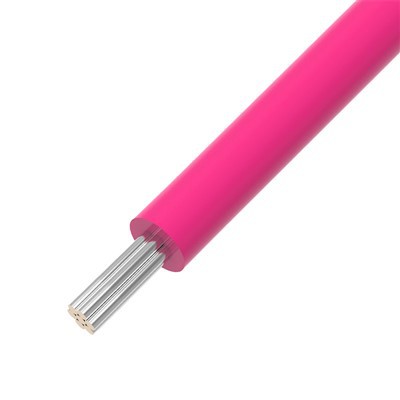
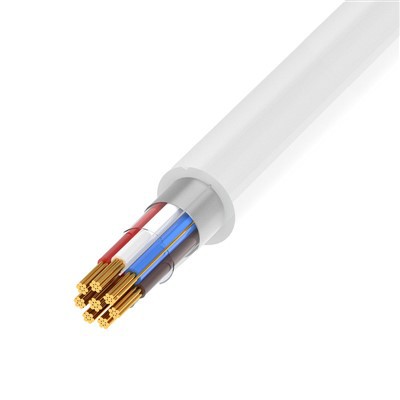
In every corner of modern society, power cables act like invisible blood vessels, transporting electrical energy to a wide range of electronic devices and supporting the operation of human civilization. These seemingly simple bundles of wires actually carry profound scientific significance-they are not only the physical medium for energy transmission, but also the culmination of a multidisciplinary fusion of electromagnetism, materials science, and electrical engineering. From microscopic electron transitions to macroscopic power grid systems, the existence and optimization of power cables profoundly impact the efficiency and manner in which humans utilize energy.
The Physical Nature of Energy Transmission
The core function of power cables is to enable efficient transmission of electrical energy. According to Ohm's law (I = V/R) and Joule's law (Q = I²Rt), when current passes through a conductor, it generates voltage drop and heat loss. This requires that power cable design strike a balance between conductivity, resistivity, and mechanical strength. Copper and aluminum, as mainstream conductor materials, are ideal choices for their high conductivity and relatively affordable cost. Copper has a resistivity of only 1.68×10⁻⁸ Ω·m, while aluminum's is 2.82×10⁻⁸ Ω·m, both significantly lower than common metals like iron. The emergence of superconducting materials has further expanded theoretical limits: below a critical temperature, the resistance of certain materials (such as yttrium barium copper oxide) completely vanishes, theoretically enabling lossless transmission. While currently limited by extremely low temperatures and high costs, this technology has pointed the way forward for future power cable technology.
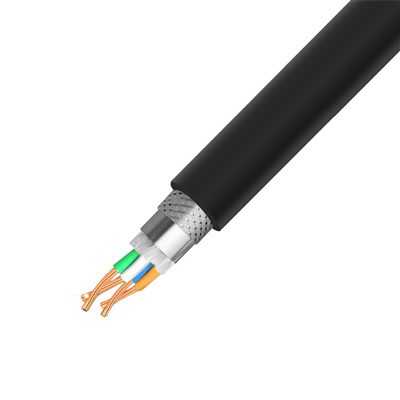
Electromagnetic compatibility (EMC) is another key scientific consideration in power cable design. Fluctuating currents generate alternating magnetic fields, generating electromagnetic interference (EMI), which can affect the normal operation of surrounding electronic equipment. Modern power cables effectively suppress both common-mode noise and differential-mode interference through twisted-pair construction, shielding layers (such as aluminum foil or braided copper mesh), and appropriate grounding. For example, the shielding layer of USB 3.0 data cables can reduce radiation to below 30 dB, ensuring stable high-speed signal transmission. Power cables specifically designed for medical devices must comply with the IEC 60601-1-2 standard, keeping electromagnetic leakage within strict limits to ensure patient safety.
A vehicle for innovation in materials science and engineering
The evolution of power cables is essentially a history of advancements in materials science. Early rubber and silk insulation layers were prone to aging and cracking, while modern cross-linked polyethylene (XLPE) insulation can maintain mechanical strength and dielectric properties for long periods at 90°C. Its breakdown field strength can reach 20-30 kV/mm, far exceeding that of air (3 kV/mm). The introduction of nanocomposites has further revolutionized traditional insulation systems: adding a small amount of carbon nanotubes or montmorillonite to a polyethylene matrix can increase the space charge trap density of the insulation layer by an order of magnitude, effectively suppressing insulation degradation caused by partial discharge.
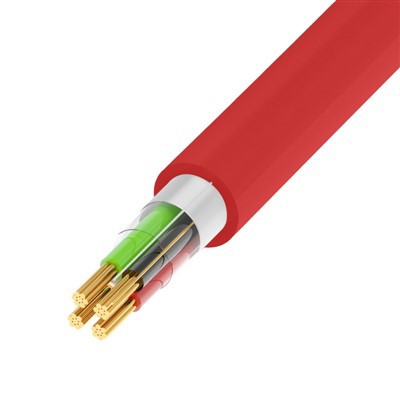
Optimization of conductor structure is also a manifestation of scientific breakthroughs. Twisting multiple strands of fine copper wire instead of a single thick conductor not only reduces the loss of effective cross-sectional area caused by the skin effect (the concentration of current on the surface of a conductor at high frequencies) but also enhances flexibility to accommodate complex wiring requirements. Tesla pioneered the use of multi-strand twisted wire in its AC power system, addressing the efficiency bottleneck of long-distance power transmission. The coaxial structure of modern high-speed data cables (inner conductor - insulation layer - outer conductor - sheath) achieves simultaneous transmission of signals and energy through electromagnetic shielding.
Social Impact on Energy Civilization
From a broader perspective, power lines are the "capillaries" of the energy internet. The global power grid relies on tens of millions of kilometers of transmission and distribution lines to build its energy flow network. Ultra-high voltage direct current (UHVDC) transmission technology (such as the ±1100 kV Jiquan Project) uses converter stations and specialized cables to transmit clean electricity from wind and photovoltaic power generation in western my country across 5,000 kilometers to load centers in the east, keeping losses to less than 5%. In a home, a standard Type-C power cable can simultaneously carry 100 W of power and 480 Mbps of data, promoting the converged transmission of "power + information" and providing a plug-and-play energy interface for IoT devices.
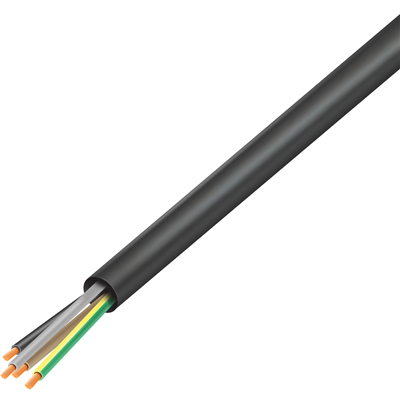
The safety design of power cables is even more directly related to public safety. Electrical fires caused by insulation breakdown and overheating account for over 20% of all fires worldwide. Therefore, standards such as UL and IEC strictly define the current carrying capacity of conductors (for example, 1.5 mm² copper wire can safely carry 16 A), temperature resistance (70°C for standard cables, up to 150°C for high-temperature cables), and flame retardancy (V-0 in vertical flame tests). The emergence of smart power cables (with integrated current sensors and circuit breakers) can even detect abnormal conditions in real time and automatically disconnect the circuit, prioritizing risk prevention and control.
Conclusion: From a tool to the forefront of science
Power cables are more than just "wires"; they are technological vehicles that embody the wisdom of multiple fields, including electromagnetic theory, materials science, and systems engineering. From Faraday's discovery of electromagnetic induction to Maxwell's complete set of electromagnetic field equations, and from Edison's direct current transmission system to Tesla's global AC power grid, every leap forward in energy transmission technology has been accompanied by innovations in power cord design. In the future, as technologies like wireless charging and room-temperature superconductivity mature, power cords may continue to fulfill their mission in new forms. However, no matter how they evolve, their scientific significance as the core hub connecting energy production and consumption remains a crucial cornerstone of humanity's journey towards a higher level of civilization.